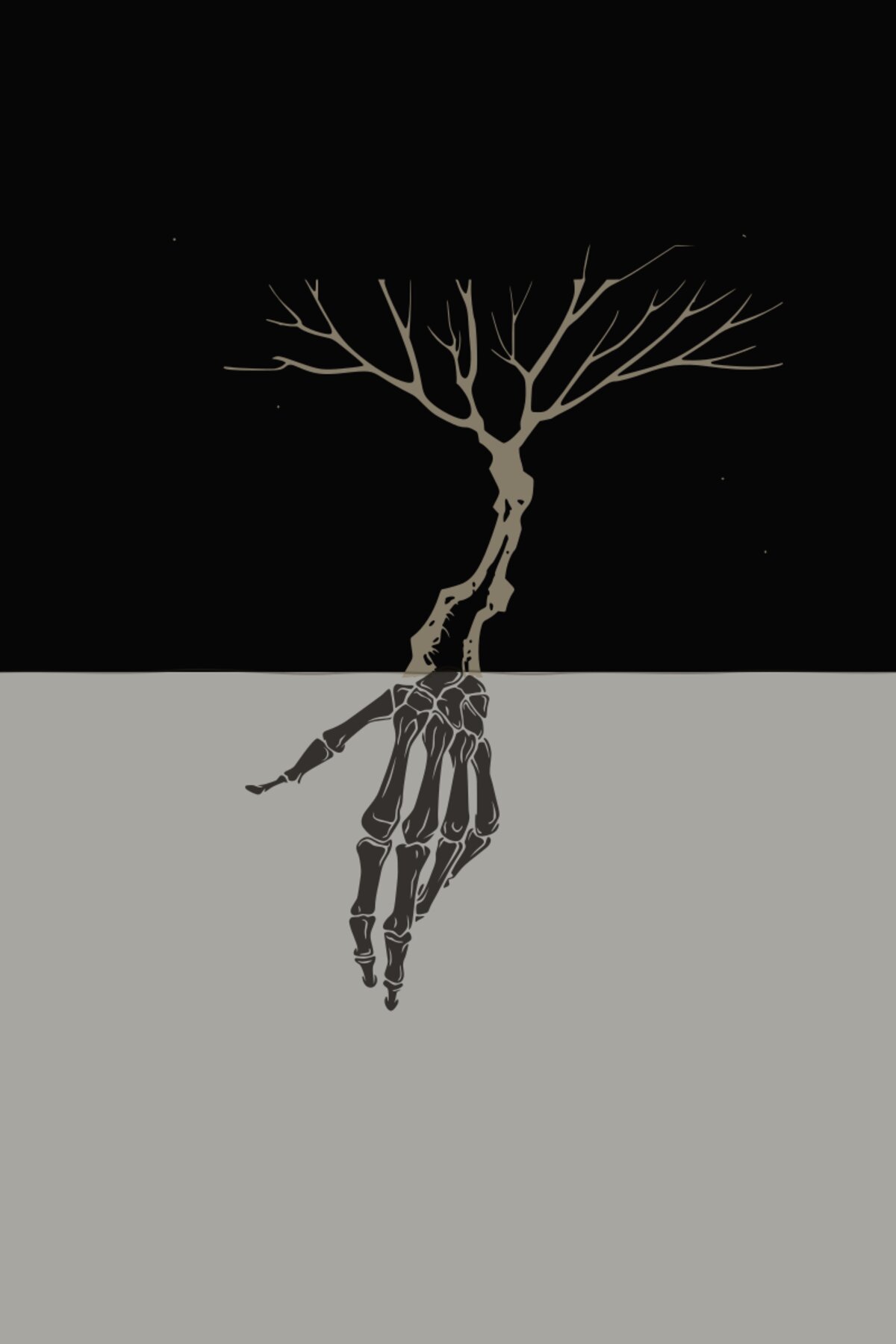
Before there was a pirate ship, before there was a Captain Hook, before Neverland had a name, J.M. Barrie sat on a bench in Kensington Gardens with a private key to the gate and wrote over four hundred notes on scraps of paper. He headed them all with a single word: Fairy.
The very first note: No one has grown up ideas (not parents or anyone).
Among those notes, in his microscopic handwriting, Barrie identified his protagonist. Not as a hero. Not as an adventurer.
P. a demon boy (villain of story).
J.M. Barrie, handwritten note, c. 1903. Beinecke Library, Yale.
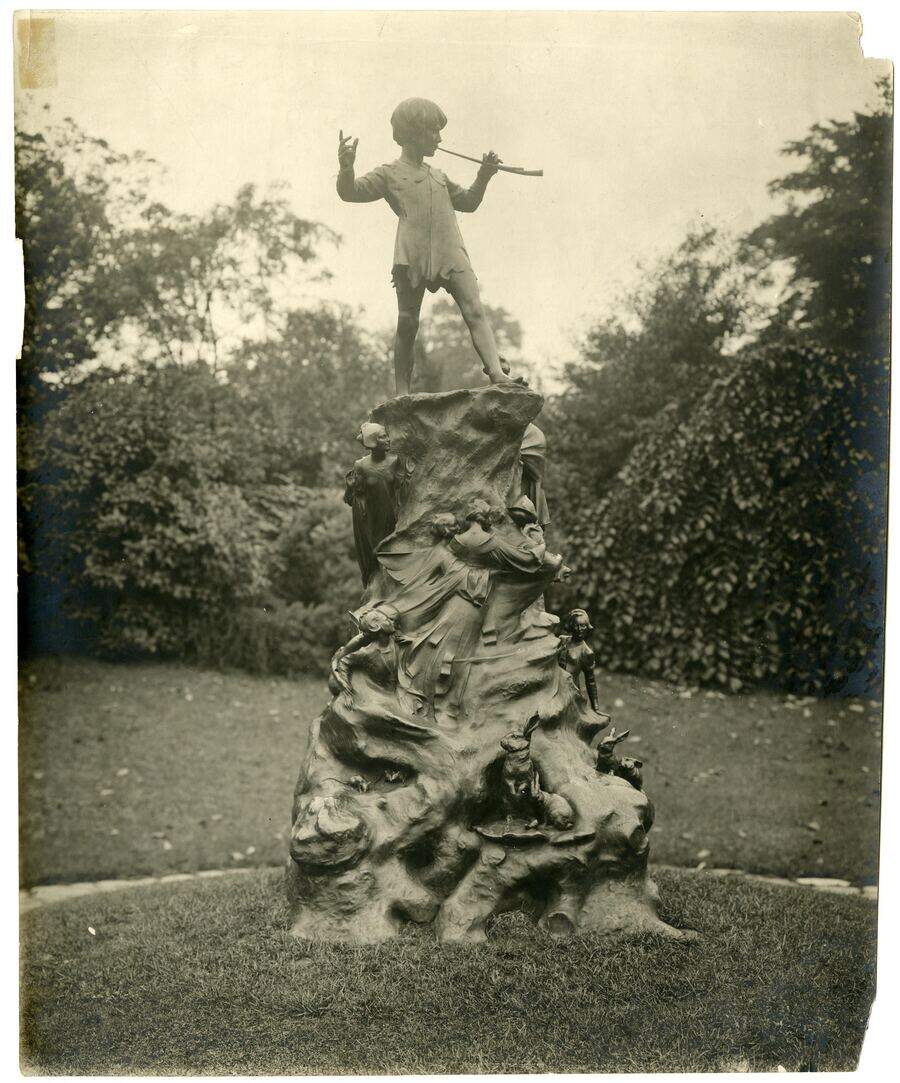
The Peter Pan statue, Kensington Gardens. Erected secretly overnight by Barrie, 1 May 1912. A demon boy on a tree stump. The horn raised but silent.
The play had no Captain Hook. No pirate ship. It had a boy who stole children from their beds in the dead of night, and that was enough. Hook was added later because the stagehands needed time to change the scenery.
And the title Barrie wanted, the one that named the wound, was replaced by something that sounded like a choice.
Kirriemuir, 1867
The Boy Who Remained
Barrie was six years old when his brother David died in a skating accident, the day before David's fourteenth birthday. Their mother, Margaret Ogilvy, took to her bed and did not fully recover.
Young James tried to replace David. He wore David's clothes. He imitated David's whistle. He entered his mother's darkened room and heard her ask a question.
I thought it was the dead boy she was speaking to, and I said in a little lonely voice, "No, it's no' him, it's just me."
J.M. Barrie, Margaret Ogilvy, 1896
His mother found comfort in one idea: that David, in dying a boy, would remain a boy forever.
The grief did something else. As a result of the emotional deprivation, Barrie developed psychogenic dwarfism. He stood four feet, ten inches tall for the rest of his life. The energy had nowhere to go. It went into the bones. His body stopped growing.
The Discarded Title
Peter Pan, or The Boy Who Hated Mothers
That was Barrie's working title. In that version, Mrs. Darling and Captain Hook were to be played by the same actress. The mother-figure doubling as the villain.
Gerald du Maurier talked him out of it and took the Hook role himself. The producer changed "couldn't grow up" to "wouldn't." And the confession in the title was replaced by something that sounded like a choice.
Birkin, Barrie's biographer, put it plainly: the tradition du Maurier initiated has no real thematic justification.
Paris, 1908
The One Time He Said It
Barrie was always reluctant to explain Peter. But in 1908, when the play was performed in Paris, he was obliged to provide a programme note. He said it once. He never said it again.
Of Peter himself, you must make what you will. Perhaps he was a boy who died young, and this is how the author conceived his subsequent adventures. Perhaps he was a boy who was never born at all, a boy whom some people longed for, but who never came. It could be that those people hear him at the window more clearly than children do.
J.M. Barrie, programme note, Paris, 1908
A boy who died young. Subsequent adventures. And the people who hear him at the window are not children but adults who lost one.
1928
"I Have No Recollection of Having Written It"
The play premiered in 1904. Barrie did not publish the script for twenty-four years. When he finally did, his preface opened with a confession.
Some disquieting confessions must be made in printing at last the play of Peter Pan; among them this, that I have no recollection of having written it.
J.M. Barrie, "To the Five," 1928
He could not find the original manuscript. Would not contest anyone who claimed authorship. The whole preface reads like a man who understood he had been a vessel for something that did not originate with him.
1929
The Patient
In 1929, Barrie gave the copyright to Peter Pan to Great Ormond Street Hospital for Children. Everything. The play, the novel, every adaptation.
His explanation:
At one time, Peter Pan was an invalid in the Hospital... and it was he who put me up to the little thing I did.
J.M. Barrie, 1929
He spoke of Peter as a patient. Not a character. He requested the royalty amount never be revealed. The hospital has honoured that for nearly a century. In 1988, the House of Lords granted the hospital royalties from Peter Pan in perpetuity. The copyright will never expire.
1910
The Altered Will
When Sylvia Llewelyn Davies died, Barrie copied her handwritten will. His version said she wanted "Jimmy" to look after the boys. Biographer Andrew Birkin later found the original. It said Jenny. The nanny's sister.
Whether misreading or alteration, the result was the same. Barrie became the primary guardian of the five boys he had been weaving into a fairy tale since they were in prams.
The Record
The Fatal Touch
D.H. Lawrence, 1921: "J.M. Barrie has a fatal touch for those he loves. They die."
David BarrieBrother. Skating accident. Age 13.
Arthur DaviesFather of the five. Cancer. 1907.
Sylvia DaviesMother of the five. Cancer. 1910.
George DaviesEldest son. Killed in action. Age 21. 1915.
Michael DaviesFourth son. Drowned at Oxford. Age 20. Possibly a suicide pact. 1921.
Peter DaviesThe boy named Peter Pan. Threw himself under a train. Age 63. 1960.
Bobby DriscollDisney's Peter Pan. Dead at 31. Unmarked grave. Hart Island.
1945 - 1960
The Morgue
Peter Llewelyn Davies spent his last years assembling family papers into a compilation he called the Morgue. He called Peter Pan that terrible masterpiece. He destroyed most of the letters between Barrie and the Davies boys.
They were too much.
Peter Llewelyn Davies
At the time of his suicide, he had reached the section about his brother Michael's drowning. He stopped there. The headlines the next morning called him Peter Pan one last time.
1904 - Present
The Women Who Played Him
Mary Martin. Sandy Duncan. Cathy Rigby. Allison Williams. Peter Pan has been performed by a female body pretending to be a male child for over a century.
Barrie wanted the mother and the villain played by the same actress. The tradition that stuck was different: women playing Peter himself. The original casting insight, that the mother and the boy are linked, traveled through the wrong channel, the boy's body instead of the villain's identity, and the result is a century of audiences watching something they can feel is off without being able to name why.
The Signal, Received and Filtered
What Each One Caught. What Each One Cut.
Disney
1953
Replaced Barrie in the collective imagination. Put Peter in green tights instead of skeleton leaves. Stripped the carcass away. Made the costume match the tone they wanted instead of the tone Barrie wrote.
Signal received
The flight. The fun. The crowing. Neverland as paradise. The clapping.
Signal lost
The dreams about the riddle of his existence. The thinning. The Never tree. The forgetting as architecture. "Heartless."
Hook
1991
The first major attempt to ask "what if Peter grew up?" Got halfway to the door and furnished the hallway instead of going through. Peter's adulthood isn't grief-driven. It's banality-driven. He's boring, not broken.
Signal received
The midlife crisis. Adulthood as forgetting. The return to play. Hook alone, asking what the world would be without him.
Signal lost
The wound. Peter didn't stop flying because of a deathbed vow. He stopped because he got a job.
Peter Pan
2003
Restored the father-villain doubling. Got closest to the tension between Peter and Wendy. Changed "to die would be an awfully big adventure" to "to live would be an awfully big adventure." The inversion shows the anxiety. They knew the line was about death. They reversed it and hoped the energy would carry. It didn't.
Signal received
The sexual tension Barrie wrote. The doubling restored. The darkness of Neverland.
Signal lost
"To live" doesn't have the weight "to die" has. The substitution is the thimble instead of the kiss.
Pan
2015
The "origin story" attempt. Spectacle as depth. Neverland as a mining colony. Peter as a chosen one. Tried to answer "where did Peter come from" with plot mechanics instead of psychological architecture.
Signal received
The desire to know the origin. The visual darkness.
Signal lost
Everything. A prophecy and a pixie-dust mine instead of a deathbed and a vow.
Wendy
2020
Replaced Neverland with a Louisiana bayou. Aging rendered as literal physical transformation. The closest any adaptation has come to the body horror. Still asked "what if" instead of "why."
Signal received
Aging as the central terror. The body as the battleground. The cost of staying.
Signal lost
The wound that precedes the island. Without the deathbed, the refusal has no engine. The body horror has no origin.
Peter Pan & Wendy
2023
Centered Wendy's agency. Gave Hook a backstory as an orphan who once flew with Peter. The correct instinct, that Peter and Hook are mirrors, filtered through a narrative that still couldn't explain what they're mirrors of.
Signal received
Peter and Hook as former friends. The mirror. Wendy as the one who chooses to leave.
Signal lost
The mirror is not friendship. It's a composer and his instrument. Two artists who use living beings as their medium.
Peter Pan Live!
NBC, 2014
"Clap if you believe in fairies" performed at network scale. Millions of viewers sustaining something they didn't understand, instructed by a network that didn't know what it was asking them to sustain.
The Appetite
Every Adaptation Asked the Wrong Question
Wicked. Maleficent. Cruella. The culture has spent twenty years circling the idea that the fairy tales were incomplete. That the villains were misunderstood. The appetite for the darker reading is proven.
But every reimagining starts from the villain and works backward. Starts from sympathy and constructs an alternative history.
Every one of them asked what if.
What if Peter grew up. What if Hook was sympathetic. What if the origin was epic. What if Neverland was darker.
Not one of them asked the question Barrie asked once in Paris and never asked again.
Why was he the boy who never grew up?
Before Neverland
The Graves in the Garden
In The Little White Bird, 1902, Peter Pan was a baby who had flown to Kensington Gardens. After lock-out time, when the gardens were closed, he roamed. He dug graves for children who had fallen from their prams and died after dark.
He was a psychopomp from the beginning. A guide of the dead. Barrie knew this before he knew anything else about the character.
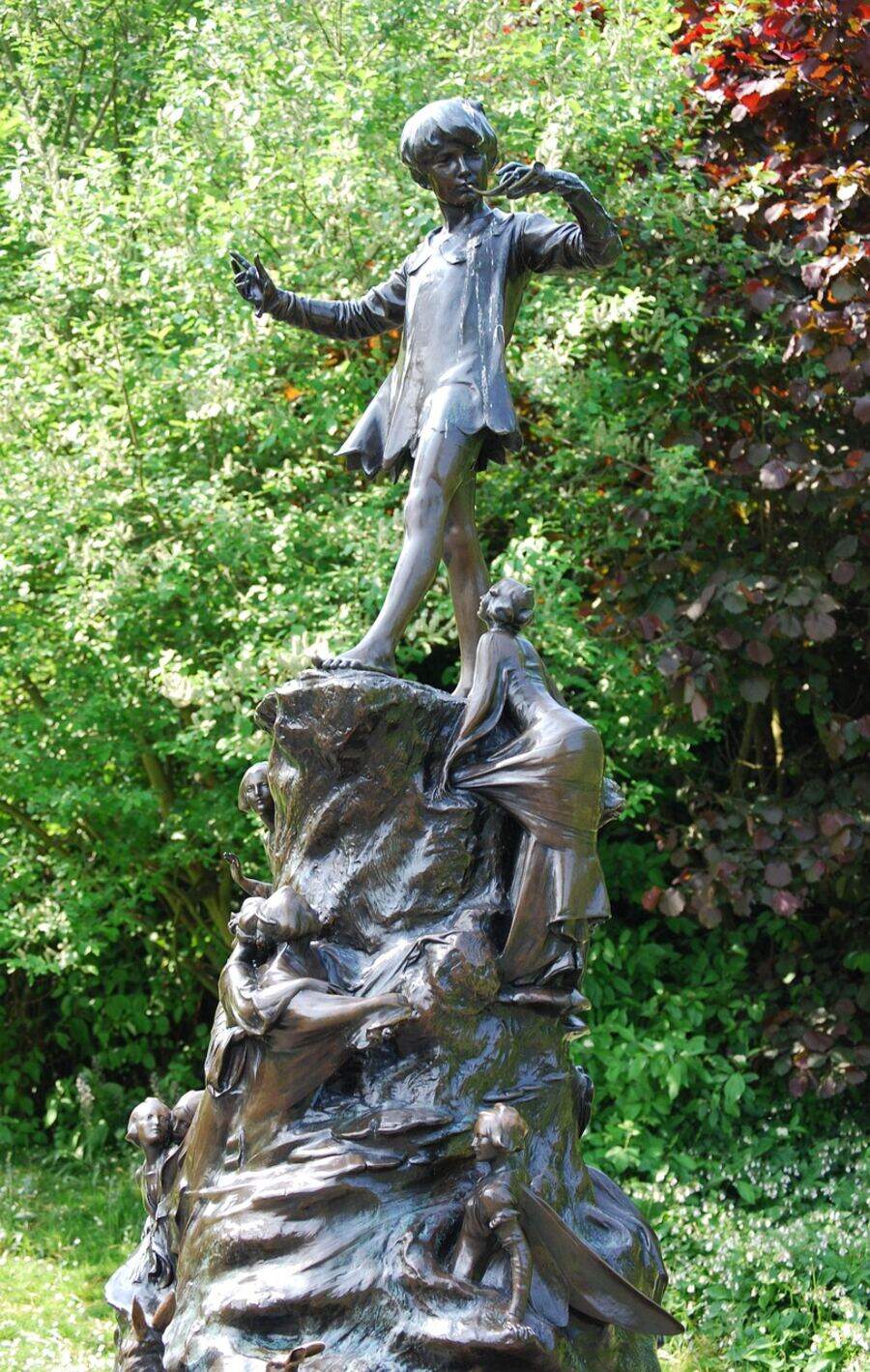
Kensington Gardens. The boy stands on a tree stump covered in fairies and small creatures. The stump is the pedestal. The tree was cut. The boy stands on what remains.
The Line
"To Die Would Be an Awfully Big Adventure"
The most famous line in the story. Quoted on posters. Printed on merchandise. Delivered with a grin.
Said by a boy on a rock in a rising lagoon, about to drown. A boy who cannot grow up, cannot age, cannot die. A boy wearing the structural remains of dead leaves, presiding over children fitted to trees by force, fed on food that doesn't exist, in a land that was never supposed to be.
He said it with a grin. The grin is the fairy-tale register. The line beneath the grin is the confession.
Every adaptation that repeated this line treated it as courage. It was not courage. It was a boy who had already died telling the audience what he knew.
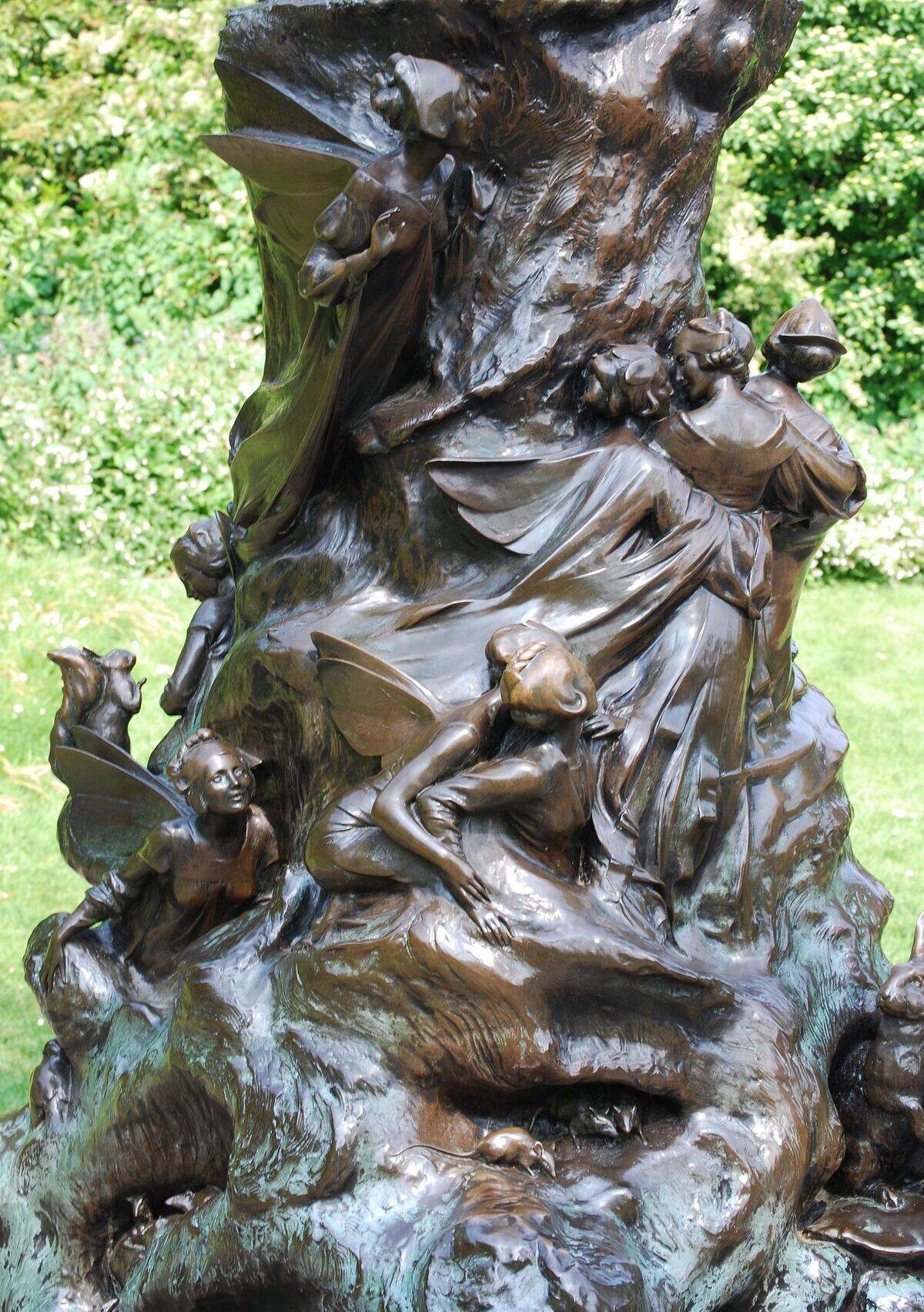
The base of the statue. Fairies and creatures climbing the stump. The tree that was cut. The things that grew from what remained.
Hidden in Plain Sight
What Nobody Asked
Why does Peter wear skeleton leaves?
The structural remains of dead leaves. All living tissue rotted away. He is wearing carcasses.
Why are the trees custom-fitted?
"Peter measures you for your tree as carefully as for a suit of clothes: the only difference being that the clothes are made to fit you, while you have to be made to fit the tree." And if you don't fit: "Peter does some things to you, and after that you fit." The sentence was built to be moved on from.
How do you enter them?
Draw in your breath and down you go. To ascend, draw in and let out alternately. Circular breathing. Into hollow spaces in the ground, fitted to your body. Coffins played like instruments.
Why does the tree grow back every morning?
"A Never tree tried hard to grow in the centre of the room, but every morning they sawed the trunk through, level with the floor." Three words earned: tried hard. Growth rising nightly. Severed before it can threaten the premise. Every single morning.
What does Peter eat?
Make-believe. "Make-believe was so real to him that during a meal of it you could see him getting rounder." The delusion is the food supply. It physically sustains. And the children must follow his lead or starve.
What does Peter dream about?
"Sometimes, though not often, he had dreams, and they were more painful than the dreams of other boys. For hours he could not be separated from these dreams, though he wailed piteously in them. They had to do, I think, with the riddle of his existence." Wendy held him during these episodes. He never knew.
Why does Peter forget everyone?
"I forget them after I kill them." Memory requires acknowledging time. Time means growing. Forgetting is not a flaw. It is structural.
Why does he come to the window and never the door?
Doors are how the living enter. Windows are how the dead watch.
What is the last word of Barrie's book that matters?
"And thus it will go on, so long as children are gay and innocent and heartless." The loop. Endless. Each generation providing a new mother for the boy who cannot grow. Heartless.
The Loop
The Trap Nobody Noticed
Barrie's final paragraph is the cruelest sentence in children's literature. Wendy grows up. Her daughter Jane takes her place. Jane's daughter Margaret takes hers. And thus it will go on.
An endless procession of daughters, generation after generation, sent to mother a boy who forgets them the moment they leave. Each one opening the window. Each one flying. Each one coming home. Each one being replaced.
Barrie wrote the loop as melancholy charm. He punctuated it with "gay and innocent and heartless" and left the reader with what sounded like a sigh.
It was not a sigh. It was a diagnosis. A closed system. A story with no exit. The boy at the window forever. The daughters forever arriving. The forgetting forever erasing. And nobody asking why, because the fairy-tale register was so effective that generations of readers absorbed the horror as whimsy and never looked down at the blood soaked hands of the narrator.
The signal kept broadcasting. The speakers kept distorting. A hundred years of well-funded attempts to tell this story, each one catching a fragment, none holding the whole frequency.
The signal kept broadcasting until it found a receiver.